
Module Launch/Initial ideas


During the module launch, we discussed how visual choices create a story, and what a story is. I thought about what narrative devices i am naturally drawn to, and how i can make a story personal. I am excited by this brief as i read a lot of fiction and have been looking for a project where i can combine my love of story telling and illustration. I am thinking about visual baggage and what that means for stories with little in terms of visualisation- Ursula K Le guin’s sci fi novels comes to mind – however there is a severe lack of adaptations to work off of.

My inital ideas go straight to my favourtie author, Ursula K Le Guin. Her fanatasy sci-fi worlds have been an inspiring force for me and I have always wanted to visualise her world building. Here i am creating mind maps on her different writings, thinking about which piece to choose, or if i should create an anthology of her different works all together? I am trying to highlight her overarching themes : humans and nature; no simple questions and no simple answers, self discovery, troubled yet powerful characters…

Tom abba lecture got me thinking about misdirection and mental decoding in story telling… and also doodling
Anthology Workshop


The anthology workshop got me thinking about visual storytelling and how images fit within/alongside text. We have formed a group to focus on Anthony Cartwright’s Necrosmologies. As a group, we allocated stories and then discussed colour pallets and how we wanted to illustrate each short story.
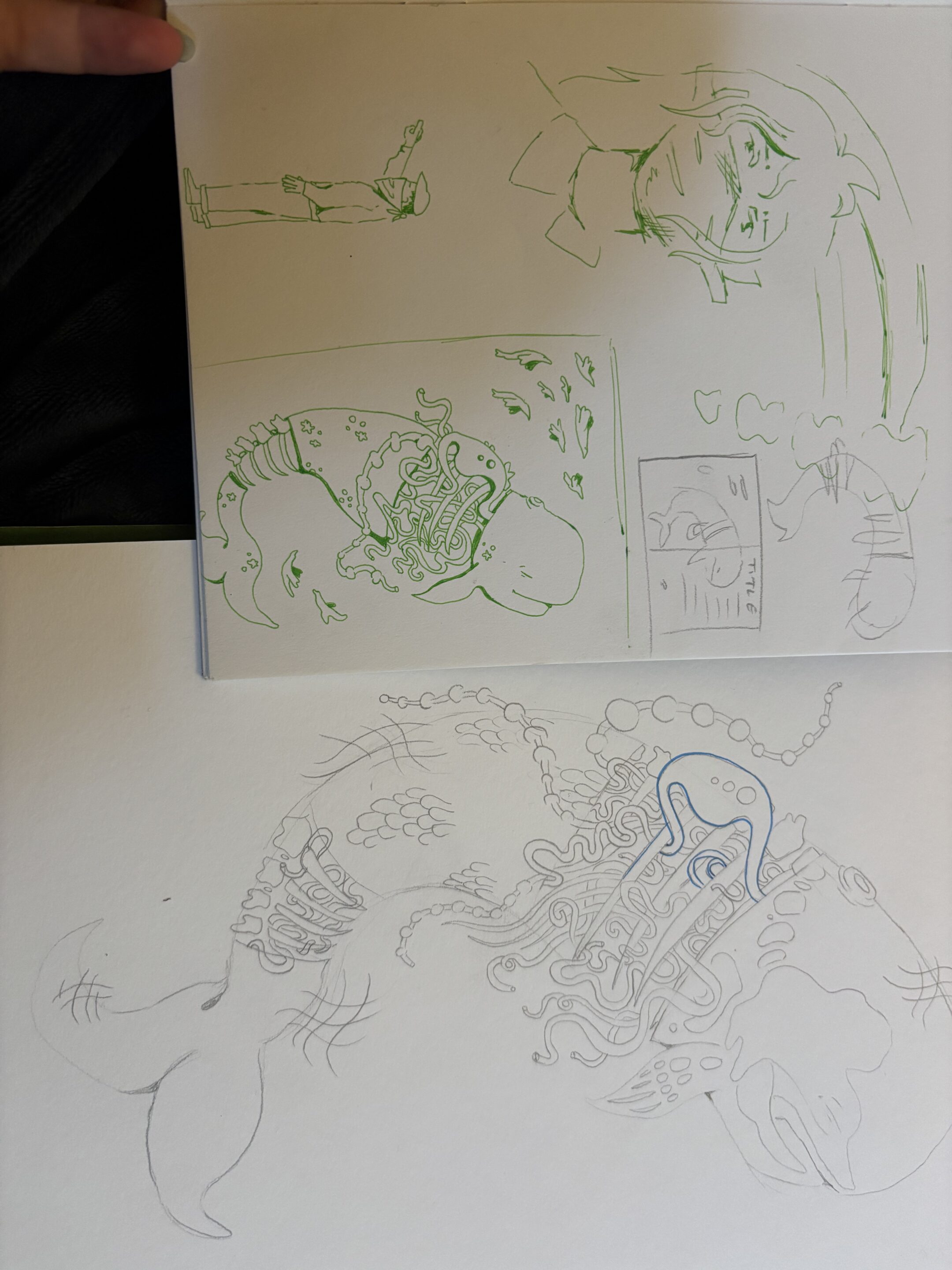


On the left is my final illustration, i am happy with the outcome, i like how the image has subtle symbolism within the peace dove on the bottom left, as my story “desert snows” is about a whale carcass, decomposing in a city, symbolising a bomb. here is the link to our final pdf https://drive.google.com/file/d/1Rs9dLcr8F6_-esL-MChztJsWbD86T4qO/view?fbclid=PAVERFWATEjUlwZG9mAmV4dG4DYWVtAjEwAHNydGMGYXBwX2lkDzEyNDAyNDU3NDI4NzQxNAABp12fZ5nD6XcwTpDJpnNtNZWCsEhFNp9ACkauZBpO9nkEZMxlO3sXbnCKo0j9_aem_to8-gjegQOADehdHV0C38A , i think its strange that we decided to display out anthology in a basic picture book style, this couldve been a bit more thought out, with how it would be printed and presented as a publication.
Narrative Research
99 ways to tell a story


99 ways to tell a story is an anthology book, retelling the same story 99 different times, shifting the visual narrative in each retelling. It is based on the book “Exercises in Style” which tells the same story 99 times but in different literary styles. I have found this book to be incredibly helpful when thinking of different narrative structures when visualising a comic. I am intrigued by methods such as pacing: using lots of panels in one page to create a rushed pace, or having a one panel for a whole page to create a slower feel, this is a really clever way of controlling simple visuals to inform the reader on a specific atmosphere which then informs the narrative. I am also thinking about perspective and narration, with excercises in style displaying pages on monolouge and subjective narrative structures- this could be a good narrative method to use in a complicated sci fi story as one character could be explaining the undertones and history of the complex world or characters.
a girl walks home alone at night - behemoth


In this Iranian vampire comic, Ana Lily Amirpour creates a deep and spooky atmosphere with her dark high contrast double page spreads, contrasting close ups with long shots to create intimacy. I like how the subject creates eye contact with the viewer in this way, it makes you feel involved in the story.
Tongues by Anders Nilsen

I really like how nilsen creates an unspoken and complex connection between characters with the abundance of panels in this spread, the images speak for themselves in a slightly strange and beautiful way. I think the lack of text is really effective when convaying a complex situation which is sometimes just better explained with visual langauage rather than regular language.

I like how this spread introduces the first character alone and then brings the next character into scene and shifts into a subjective narrative structure from the point of view of the second character, I also like how this shift is transitioned by the geometric shapes of the panels in the top right corner, this clever layout smoothens out this narrative shift.
Green Graves- Liam Cobb


These pages from Green graves have a really strong visual language, the grey textured landscape creates a serious moodiness, with the stark contrast from on spread with lots of panels to the next spread being only one panel creates a nice pacing variety and mirrors the characters journey through the pages.
Square Eyes - Mill+Jones

Square eyes is a kaledescopic graphic novel that balances on the boundaries of dreams, memory and the digital world. Not only is the visual langauge rich with layers and dual meanings, but the narrative structures are extremely inteligent and captivating. You are left to try and navigate through a futuristic dream world alongside the character, the narrative takes you along the same journey which Fin is left confused by. I really like this opening spread, with loads of close up panels, it creates a fast paced read with lots of information but no “big picture”, leaving the reader with lots of bread crumb trails to follow.

You are then taken into this busy, loud and colourful world where the lively atmosphere seeps through the page in immense detail.

This epic spread is one of my favourties. Leaving the reader a massive two page image to showcase the crossover of realities, the image is big like the moment that the character, Fin, is experiencing.
Kafka - Nishioka Kyodai


Nishioka Kyodai takes Kafka’s bizarre stories and rein=magines them in a dreamy abstract format, these hyper contrast patterns interestingly tell a story resembling kafka’s vision in a totally unique way. The disconnected panels and line work takes you on a bit of a trip, sismilar to Kafkas stories
Edena - Moebius


Moebius is the sci fi comic king and his work is really inspiring, from character design to storyboarding. In the Art of Edena, you can see how his powerful linework sets the basis for his storytelling and worldbuilding. I love his colour selection and landscapes.
Ursula K Le Guin
As I have already chosen to narrate Le Guin’s work, I need to select which novel I want to focus on. I have some contenders : a book from the Earthsea series, possibly Tehanu, dragons and high fantasy in an epic battle to cure magic and save the world with some very girlboss undertones; Rocannons world, a fanstasy sci fi masterpiece following an anthropologist in a new world with a variety of life forms; City of Illusions, earth in the future, how the people naviagte a new world overtaken by nature and how the goverment are hiding something very mysterious….


In a tutorial with Paul, we discuss my ideas and I think i am keen to use this module as a proof of concept for a larger project in 3rd year, using this time to experiment with narrative and sci fi comics. we discussed design process and looking into influences, as well as how to make characters beliveable in made up worlds. Create a concincing design that relates to the probable world. This conversation inspired me to be more decisive with my text selection, as this is a complicated story i must select a section to narrate. Rocannons world has a great prolouge called Semley’s Necklace, which not only introduces the world and its inhabitance but sets a really interesting theme for the duration of the book and Le Guin’s other sci fi works. Here I am beginning to research themes and moments in semley’s necklace.

here are some notes i made refering to semleys necklace after re reading and then researching book reviews and critiques online. ” fairytales decked out in spacesuits” is a quote i liked. I think at this point i am getting too cuaght up in the philisophical meanings and political messages within the prolouge and i should just start drawing somthing. I want this research to inform my visual language, especially Toaism as that is very relevant part of Le Guin’s practice and it can be seen in her writing- the balance between good and bad- there are often very flawed yet incredible characters in her worlds, reflecting this idea of toaism and the balance between all, cant have good without bad sort of thing.
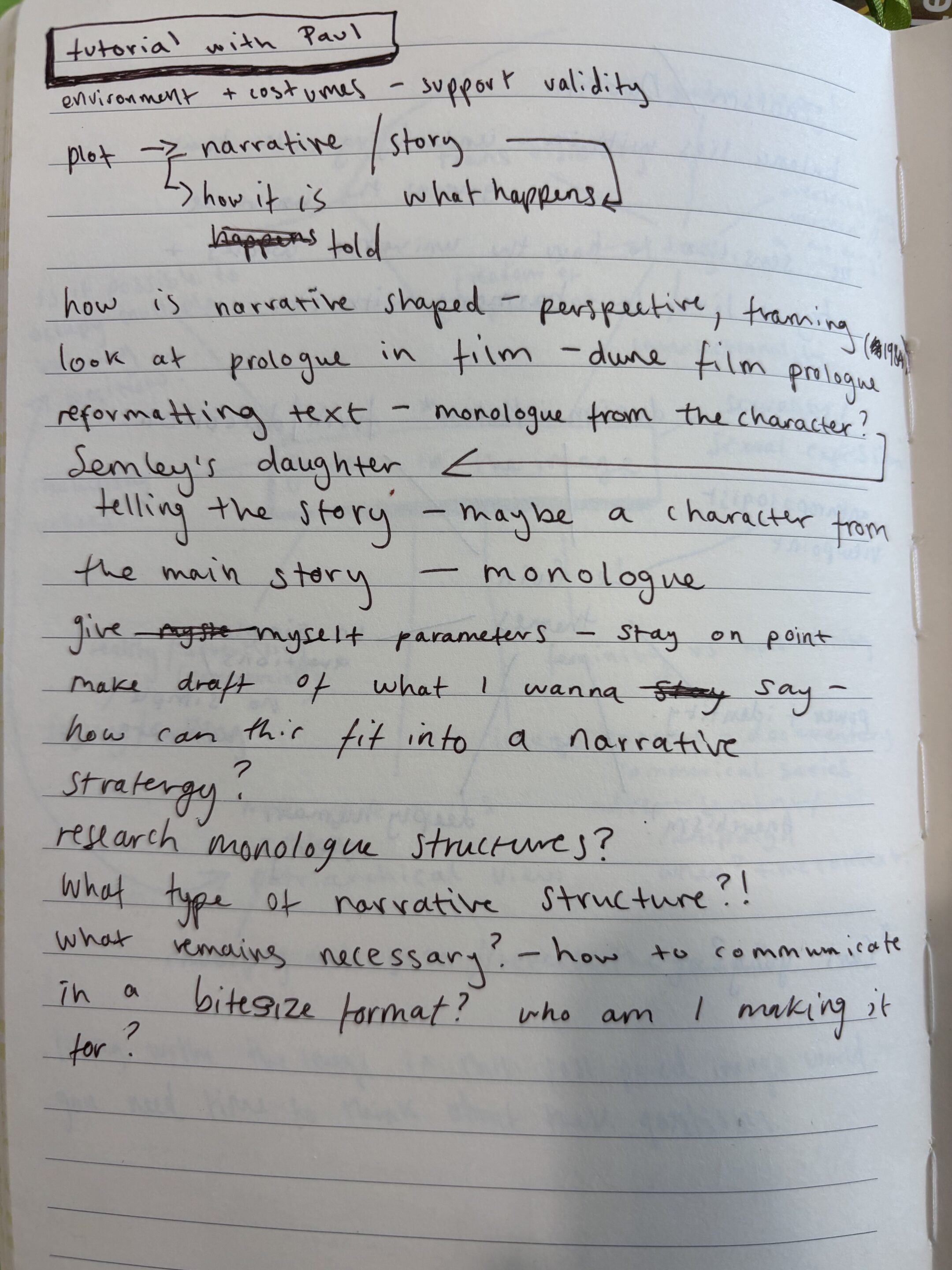
in my last tutorial with Paul, we discussed monologue as a narrative structure and he referenced a monologue from one of the dune films, in which a character explains the backstory before the events of the film take place. I am thinking about what it is i want to capture and i must make a draft of that to work from .
Slop! (a separate narrative project)
During the course of this module, i have been creating a short comic for my friends zine called Slop! this issue is themed “transit” so i decided to create a comic about cycling, and how it makes me feel like im riding a mythical creature in a fantasy world. This was a fast turn around but i thought it was also relevant to this module as i created a comic and considered narrative structures.


here are some rough sketches, figuring out form and design.


I like how this double page has a sort of animated feel, with the different “walk cycles” to create movement which is read from left to right.
